Marquette, MI · Garage Door Service
Off-track garage door repair for Marquette, MI homeowners in 1960s-70s housing with cold-climate track binding and worn rollers pulling doors off their rails.
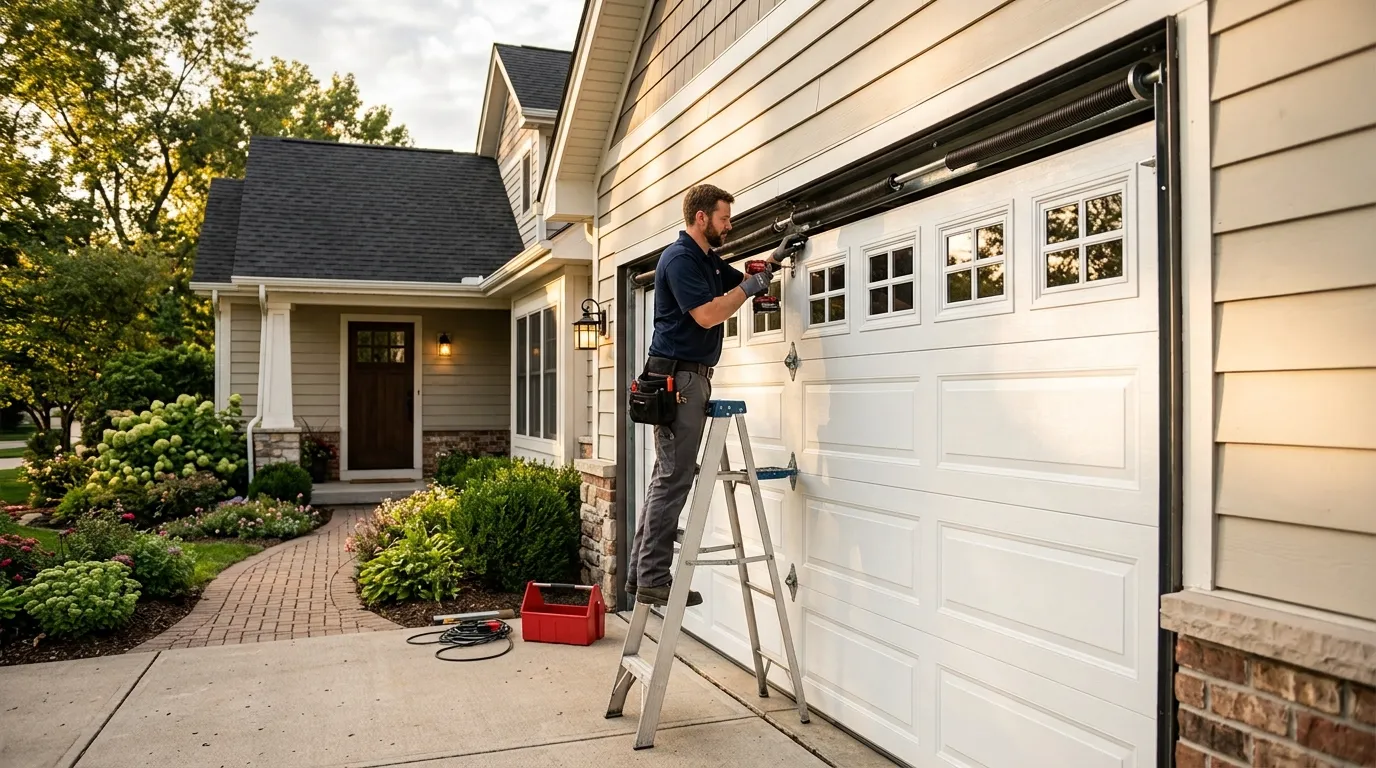
An off-track door means one or both bottom rollers have jumped the rail, or the rail itself has bent or pulled away from the jamb. The fix starts with getting the door safely down and the opener disconnected before anyone touches a roller or cable, because a door hanging half off its track under spring tension is not something to force back into place by hand.
From there the job is mostly diagnostic: check whether the roller wore through and slipped, whether a bracket came loose from the framing, or whether the rail took a hit and bowed. On a lot of the houses in this area, the rail is original - steel that's been in place since the door itself went in, mounted with hardware nobody stocks new anymore. Repairing that rail usually means matching it to what's there rather than swapping in a modern replacement, or replacing the whole run if the metal's too bent to true up. Rollers get swapped for nylon if the old steel ones are the culprit. Cables get checked while everything's apart, since a fraying cable is often what let the door swing sideways off the rail to begin with.
We don't consider it finished until the door runs the full cycle without binding or scraping the weatherstrip.
Most calls for this start with a sound, not a stall. The door groans or bangs partway through a cycle, then hangs at an angle instead of sitting flush against the opening. Sometimes it's subtler - the door still moves, but one corner drags along the track with a metal-on-metal scrape that gets worse every time it runs.
Other owners notice it visually before they hear anything: a gap opens up between the bottom panel and the floor on one side, or the door sits crooked in the frame when it's down. If a roller has fully jumped the rail, the door usually won't move at all - the opener strains against it and either stalls or reverses.
A door that's been running rough for a while sometimes throws a cable at the same time it comes off track, since the two problems feed each other. If you hear a loud pop followed by the door refusing to move, treat that as a stuck job, not a DIY afternoon - a cable under tension that's already failed is dangerous to be near.
Housing in this service area was mostly built between 1941 and 1988, with the median year landing around 1971, and a lot of it is original steel track riding on hardware from that same era. That hardware wasn't built to flex - it was built to hold a lighter door in a stable temperature range, and it's been doing that job for fifty-plus years on brackets that have loosened a little more with every winter.
This area sits in a cold climate band with severe winter swings, and that's the piece that actually pushes a marginal bracket or a slightly worn roller into an off-track failure. Steel track contracts in a hard freeze. A rail that's a quarter-inch out of true in July can bind or pop a roller free in January once the metal shrinks against it. Add road salt and moisture cycling through an unheated garage and the fasteners holding the rail to the jamb corrode a little every season, until one hard-freeze morning is the day it finally lets go.
Of the roughly 8,020 owner-occupied houses across this area, a large share were built during that same stretch of construction, so the same tired brackets and bent rail show up on job after job - it's not one bad batch of hardware, it's the housing stock itself aging on a predictable clock.
You can safely do a few things yourself. Check whether the track bolts to the framing are loose and snug them up. Look at the rail for an obvious bend or a bracket pulled away from the wall - if you see it, that's useful information for whoever comes out, even if you don't fix it yourself. Clearing debris or ice buildup from inside the track is fine too.
What you shouldn't do is put the door back on the rail with the springs still loaded, or try to force a bent rail straight while the door's hanging on it. A torsion spring holds enough stored energy to break fingers or worse, and a door that's already partway off the track can drop the rest of the way while you're working underneath it.
Honest limitation: if the rail is bent badly enough that it won't true back up, or the door is old enough that matching brackets isn't realistic, replacement of that section - or sometimes the whole door - beats trying to nurse an original 1970s track along for another decade. We'll tell you straight which side of that line your door is on rather than billing you for a patch that won't hold through next winter.
Usually it wasn't sudden - a roller had been wearing thin or a bracket had been loosening for months, and a cold snap or one rough cycle was the final push. In this climate, steel track contracts in a hard freeze, which is often the moment a marginal roller finally jumps the rail.
Not if the springs are still under tension or the door is hanging at an angle. Forcing it back can snap a cable or drop the door. Disconnect the opener, leave the door where it is, and get someone out who can release tension safely before touching the rail.
Depends on the age and condition of what's there. If the rail is original steel from a build in the 1941-1988 range and it's bent past truing up, matching brackets can cost more than it's worth - at that point a full rail or door swap is usually the better spend.
Yes. This area's cold climate band puts real stress on old track hardware - metal contracts, fasteners that were already loose pull tighter against corroded holes, and a roller that was barely holding on in fall often lets go on the first hard-freeze morning.
By Neighborhood
We also handle off track repair in these Marquette-area suburbs.
Call now or request a free quote - same-day service on most repairs, upfront written pricing.