Marquette, MI · Garage Door Service
Broken spring, dead opener, or a stuck door in Marquette's cold winters? Here's what emergency garage door repair really involves before you call for help.
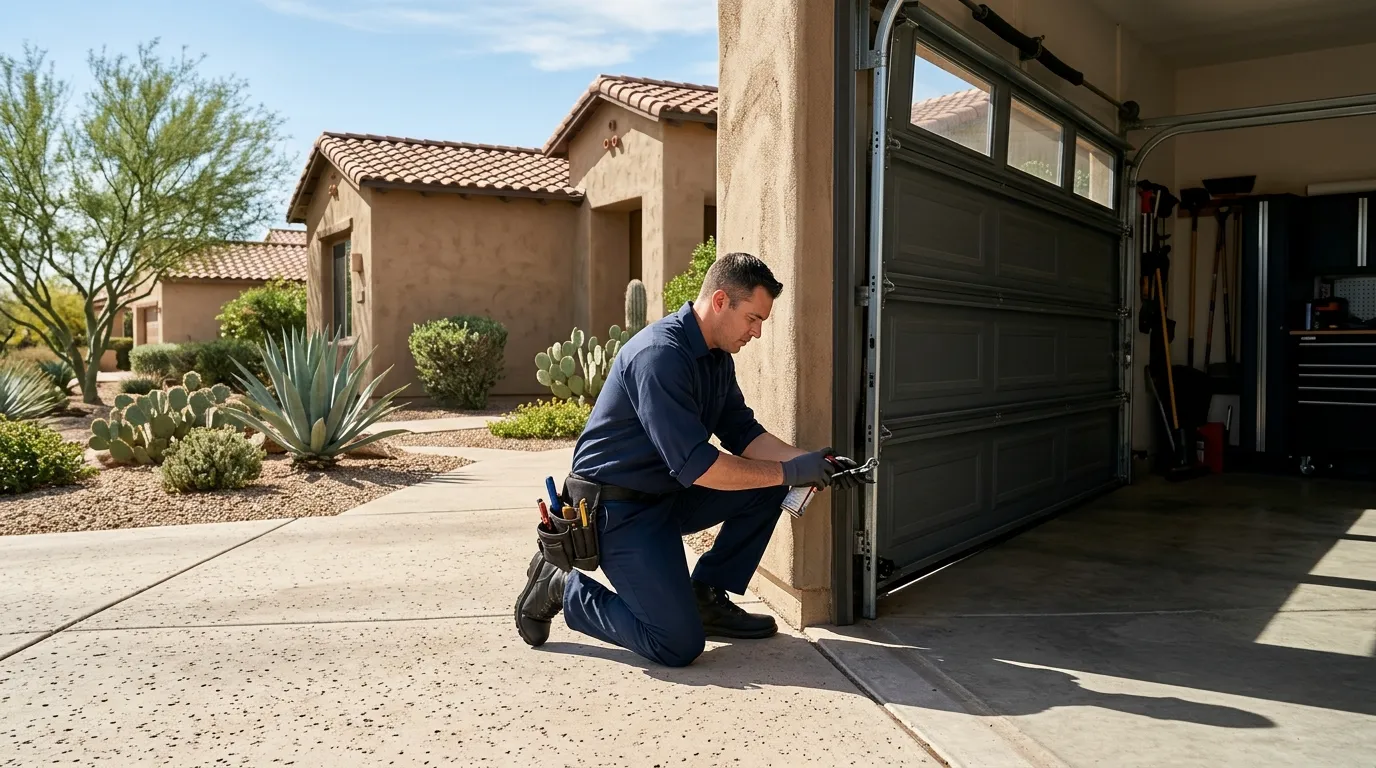
An emergency call almost always comes down to one of four things: a broken torsion or extension spring, a cable that's jumped the drum, an opener that's stopped responding, or a track that's bent enough to bind the rollers. The first job on any of these is getting the door under control - locked down if it's stuck open, propped safely if a spring has let go so it doesn't come down on anyone.
Spring replacement means matching wire size, wind direction, and length to the door's weight, not just grabbing the nearest one off the shelf. A mismatched spring either won't lift the door or will wear out the opener trying. Cable work means checking the drum and the other cable too, since if one side went under stress the other side is usually close behind.
Opener failures split into two kinds: the motor itself, or the sensors and logic board around it. A dead motor on a 20-plus-year-old unit usually isn't worth chasing parts for. A tripped safety sensor or a fried circuit board after a power surge is a smaller, cheaper fix.
We don't quote a price without seeing the door - a bent track on a two-car door and a single stripped gear on an opener are not the same job, and pretending otherwise before we're on site would be a guess, not a quote.
Most calls start the same way: the door won't move, or it moves partway and stops. Sometimes there's a loud bang first - that's a spring letting go, usually while the door is closed and under full tension. Other times it's quieter: the opener hums but the door doesn't budge, which points to a stripped gear inside the unit or a spring that's lost enough tension that the motor can't do the lifting alone anymore.
A door that runs crooked, drags on one side, or pops off the track partway through its cycle usually means a cable has slipped the drum or a roller has worn out of its channel. If you hear grinding or see the door hang unevenly when it's about halfway up, stop opening it by hand - that's exactly when a loose cable can whip.
Across the roughly 8,020 owner-occupied houses in this service area, the failure pattern tracks pretty closely with the age of the garage itself. Original hardware from the 1960s and 1970s doesn't fail the same way a five-year-old install does - it fails slower, then all at once.
Housing in this service area was mostly built between 1941 and 1988, with the median year landing around 1971, and that stock is concentrated in 1960s and '70s construction across the ten communities we cover. A lot of those garages still run original torsion hardware sized for doors that have since been replaced with heavier insulated panels - the spring is doing more work than it was ever built for.
This is a severe cold climate, and steel contracts hard in deep winter. Springs that are already near the end of their life cycle lose the last bit of flex exactly when the cold makes the door heaviest to lift, which is why so many emergency calls land in the coldest stretch of the year rather than spread evenly across twelve months. Tracks bolted to garages built before modern bracing standards also flex more under wind load and settle out of square over decades, which shows up as binding rollers long before anyone notices the frame itself has shifted.
We cover this pattern the same way from Trowbridge Park out through Harvey, Negaunee, Richmond, West Branch, Ishpeming, West Ishpeming, and Gwinn - the housing era and the winters don't change much town to town in this stretch of the U.P.
Some of this is fair to handle yourself. Lubricating rollers and hinges, tightening loose bolts on the track, replacing a worn weatherstrip - none of that needs a call. Testing the auto-reverse safety feature is something every homeowner should do a couple times a year, and it takes five minutes.
Springs are not on that list. A torsion spring holds enough stored energy to break a wrist or worse, and the tools to wind one safely - winding bars, a properly secured ladder position, a vice grip on the shaft - are not things most garages have lying around for a once-a-decade job. Cable replacement carries the same risk for the same reason.
If the door is more than 25 years old and the opener is failing at the same time the spring is going, replacing both together usually costs less over time than patching one and having the other fail six months later. That's a judgment call worth making with someone who can see the actual hardware, not guess from a phone description.
That depends on where you are and what's on the truck already, so we won't put a number here we can't back up town to town. Call and we'll tell you straight where you sit in the queue and what the drive looks like from wherever the nearest truck is.
Cold steel loses flex, and a spring that's already near the end of its life has the least flex left right when the door is heaviest to lift. Most of the springs we replace in this area are original to houses built in the 1960s and '70s, which is a long service life finally catching up with the cold.
No. A snapped cable can let the door fall or swing unevenly, and the other cable is often close to failing the same way. Leave the door where it is, keep people and vehicles clear, and call rather than trying to force it open or closed by hand.
If both are old and one has already failed, replacing them together often makes more sense than fixing one and waiting on the other. But that's a call best made after someone looks at the actual hardware - we're not going to tell you to replace a working opener just because the spring went.
By Neighborhood
We also handle emergency garage door in these Marquette-area suburbs.
Call now or request a free quote - same-day service on most repairs, upfront written pricing.